Monday, November 21, 2011


Monday, September 12, 2011

Tuesday, April 26, 2011
Showcase of 20 inspiring web development process diagrams
Showcase of 20 inspiring web development process diagrams
There is a current trend for web design studios to display a visual graphic outlining the process they take to build a website, usually following a header of just "Process". How useful these diagrams or snippets of info actually are to a prospective customer I'm not totally sure. For me they're really just an opportunity to add a bit of pizazz to your site, when done well.
However I'm not going to spend time judging their importance or outline the benefits of including one in your site, but merely present some examples which I've come across and used as research for my own diagram.
Are process diagrams worth including on your site? What works well? What doesn't? Hit me up in the comments if I left any out.
More reading
A 6-Step General Process for Producing a Website
Are Your Designs Pixel Perfect? - My Design Process
Please enable JavaScript to view the comments powered by Disqus.


Monday, April 25, 2011
Yahoo buys IntoNow, maker of TV 'check-in' app for iOS devices | Technology | Los Angeles Times
Yahoo has bought IntoNow, a Palo Alto start-up that makes an iOS app with which users "check in" to films or television shows they're watching.
The purchase is a fast one. The app, which is also called IntoNow, launched Jan. 31 and was produced by a team of seven people. The company's chief executive, Adam Cahan, is a former employee of both Google and MTV.
"Yes that's 12 weeks later… We were all surprised to say the least but it makes a ton of sense and we're ready to rock," IntoNow said Monday in a blog post announcing the sale. "We want to grow the experiences, platforms (yes we've heard you loud and clear: Android, iPad, web-based, etc.) and countries to engage with you, our community. That takes resources and a global scale.
"Yahoo! has shown us that they are excited about what we're doing and committed to continue innovating for our community."
Yahoo and IntoNow didn't disclose how much the tech giant paid for the small start-up, but various outlets have reported the amount to be from about $17 million to as much as $30 million.
IntoNow works by using the built-in microphone on an iPad, iPhone or iPod Touch to listen to TV shows or movies playing nearby. The app, using a database of audio from programming, identifies what's on a user's TV or computer and allows a users to "check-in" to a show or movie and then share what their watching on Facebook, Twitter or via an IntoNow account.
The app can identify the TV show or movie that's playing down to the airing, episode and time of a program, for shows that are up to 5 years old. The app also produces recommendations for what to watch, based on what it identifies as a user's interests and what a user's friends have watched.
"Relying on social channels as a means for discovering content -- whether it's on a PC, mobile
device, or TV -- is rapidly on the rise," Bill Shaughnessy, Yahoo's senior vice president of product management, said in a statement. "IntoNow's technology combines the ability to check in to what a consumer is watching, engage in conversations and find related content."The IntoNow application the team has built clearly demonstrates the opportunities the technology presents across Yahoo's network, especially in regards to our video content, search, mobile and Connected TV experiences. We are excited to have the IntoNow team join Yahoo as we continue to build out these experiences."
Thursday, April 7, 2011
Woman with spade shuts down Armenia's Internet : Hot Topics
We've heard of hackers shutting down the Internet, but this is ridiculous...
A 75-year-old woman from Georgia (the country) unwittingly used a spade to disrupt Internet service to the entire country of Armenia for half a day on March 28.
The woman was illegally foraging for copper to sell as scrap when she hacked through a fiber-optic cable owned by the Georgian state railway, according to The Guardian:
"As Georgia provides 90% of Armenia's internet, the woman's unwitting sabotage had catastrophic consequences. Web users in the nation of 3.2 million people were left twiddling their thumbs for up to five hours as the country's main internet providers - ArmenTel, FiberNet Communication and GNC-Alfa - were prevented from supplying their normal service. Television pictures showed reporters at a news agency in the capital Yerevan staring glumly at blank screens. Large parts of Georgia and some areas of Azerbaijan were also affected."
Local media called the woman the "spade-hacker," but it's not joke for her. She could face up to three years in prison for damaging property, although she's been released for now on account of her age.
| April 07 2011 at 12:22 PM

Tuesday, March 29, 2011

Tuesday, March 22, 2011

Monday, February 21, 2011
TV Industry Taps Twitter and Facebook for Viewers - NYTimes.com
y the time the first ballot is opened at the Academy Awards next Sunday, millions of people will be chatting about the awards show on the Internet. And ABC will be ready.

Related
-
Blogs Wane as the Young Drift to Sites Like Twitter (February 21, 2011)
Trying to exploit viewers’ two-screen behavior, the television network has built a companion Web site with behind-the-scenes video streams, so Oscar winners will be seen accepting an award on the TV set, then seen celebrating backstage on the stream.
Experiments like this one are a sudden priority in television land. As more and more people chat in real time about their favorite shows — on Facebook, Twitter and a phalanx of smaller sites — television networks are trying to figure out how to capitalize.
It’s as if people are gathered around the online water cooler — and the television executives are nervously hovering nearby, hoping viewers keep talking and, by extension, watching their shows.
Experts like Ian Schafer, the chief executive of the digital agency Deep Focus, say that Twitter and Facebook messages about shows may well be “the most efficient way to drive tune-in.” Though it is hard to prove the link, Mr. Schafer sees it firsthand when a news segment catches his attention or a basketball game is in overtime. “I’ll say on Twitter or Facebook, ‘You have got to tune into ‘Nightline’ or ‘60 Minutes’ right now,’ and then I’ll get people saying, ‘Oh, thanks for alerting me,’ ” he said.
The water-cooler effect makes big shows even bigger — the Grammy Awards had its highest rating in a decade on Feb. 13 — and gives small shows a new way to stand out.
On the same day as the Grammys, Howard Stern demonstrated the latter with his stream Twitter posts during a re-airing of his movie “Private Parts.” Suddenly, some people flipped over to HBO2 to follow along, and Twitter executives were thrilled. Adam Bain, one such executive, wrote, “This is what fiction TV producers should do every week.”
Acts like Mr. Stern’s make television viewing more social, even if the viewers are in separate rooms (or states).
“In a sense, you are in the living room, watching together,” said Jeff Probst, the host of “Survivor,” who used Twitter to talk with fans during the show’s season premiere last Wednesday while flying from New York to Los Angeles. Mr. Probst plans to make such viewing a weekly habit this season.
Television executives say the chats deepen viewers’ interest in a show, making them more likely to watch next time. BET stunned its competitors last month when “The Game,” a sitcom about football players’ relationships with women, drew more than seven million viewers, thanks in part to fevered online chatter. Debra Lee, the chief executive of BET, said “we can now tell when something’s a hit almost immediately — by seeing how many of the trending topics on Twitter belong to us.”
Twitter generally lists 10 such trending words at a time, and in the evenings, television shows are well-represented.
Television networks as well as some technology companies, Twitter chief among them, see benefits to their business from this behavior. Dick Costolo, the chief executive of Twitter, said last week at a mobile conference in Barcelona that online conversations about TV shows turn the programs into events, “meaning people watch them as they happen,” blunting the impact of digital video recording.
He may have overstated the impact of Twitter — digital recording remains prevalent — but it is clear that many people feel they have to watch some shows as they premiere in order to keep up with conversations online.
“We know people are multitasking while they’re watching TV,” said Albert Cheng, the executive vice president for digital media for the Disney/ABC Television Group, which oversees ABC. “The question is, how do we tap into that and create a whole different consumer experience?”
“We don’t have all the answers,” he added, “but we are definitely trying different things and seeing how people are reacting.”
In this television season, ABC introduced iPad apps for two shows, the since-canceled “My Generation” and the medical drama “Grey’s Anatomy,” that sync up polls and trivia to the premieres of new episodes. Those apps, for Mr. Cheng, double as research labs.
Much of the experimentation around the online water cooler is happening on cable before it trickles up to the broadcast networks. Lisa Hsia, the executive vice president of Bravo’s digital media arm, said that its online viewing parties for “Real Housewives” reunions gave a 10 percent ratings lift to the telecasts.
“The key discovery is that we’re not just driving digital growth, we’re driving analog growth,” she said.
The experiments are gaining the attention of TV advertisers looking to leverage the online communication about their brands. For the Super Bowl last year, Nielsen created a blended media score for clients that looked at the impact of both paid media and earned media. The highest-scoring clients had what Randall Beard, the global head of advertising solutions for the Nielsen Company, described as “pass-along currency” in their social media campaigns, like a coupon.
“The best form of advertising is a recommendation from a friend and a family member,” something that social media encourages, Mr. Beard said.
During this year’s Super Bowl on Feb. 6, Twitter users set a new record by sending 4,064 messages each second, the highest number of messages per second recorded during any sporting event.
A recent study by Deloitte of 2,000 American consumers ages 14 to 75 found that 42 percent sometimes surfed the Web while watching TV, and 26 percent sometimes sent instant messages or texts.
Analysts say such behavior will become more common as tablets and smartphones become more prevalent. Programs like “The Rachel Maddow Show,” on MSNBC promote iPad apps, and ABC’s Oscar Web site will come in the form of an app.
It’s not just television networks like ABC that are eager to wedge themselves into the two-screen experience. A wide range of Web sites, including People.com and NYTimes.com, are creating Web pages and apps meant to be viewed during the Oscars next Sunday.
Mark Golin, the editor of People Digital, said the People.com site would feature real-time trivia with a $10,000 grand prize. “We do a lot of run-up content in the days and weeks before” the Oscars, he said.
“We always have a big day after. So why not during the show?”
Monday, February 14, 2011
'Pretty Little Liars' truth: Social networks sell
The curt antagonist on "Pretty Little Liars" - known only as "A" - terrorizes victims by way of text messages and the Internet. ABC Family is using the same weapons to lure its audience.
The network is banking on Twitter's 140 characters and Facebook's "like"-ability in an effort to generate buzz and strengthen the fan base of the freshman series. It doesn't end with social networking. Whether it's iPhone apps or text alerts, TV networks are finding that they have to keep up with an ever-changing social media landscape to keep young viewers interested.
It seems to be working for "Pretty Little Liars," which airs locally at 8 p.m. Mondays. The series nabbed 4.2 million total viewers for its midseason premiere last month. Not gargantuan numbers, but impressive enough for the young cable network.
"We know how influential the dialogue on social networks can be," said Danielle Mullin, vice president of marketing at ABC Family. "That was really key to our strategy. We really tried to use social media as a way for fans to become advocates for us and help get the word out about the premiere."
It also helps that the program, based on the popular young adult novels by Sara Shepard, has a built-in audience ready to help spread the word. Leading up to the series' launch, the network tapped Shepard to participate in an online media call, on which she answered questions submitted on the ABC Family "Pretty Little Liars" Facebook page. To capitalize on the show's premiere and the release of the final book in the series, the network posted Shepard's tweets containing passages from the first chapter on the "Pretty Little Liars" Facebook Fan page.
"We love Twitter; we love Facebook," said series creator Marlene King, who also has taken part in the tactic by participating in a Twitter-based question-and-answer with fans. "You're talking to people in Brazil, in China. Gosh, if I were 14 years old and I could've tweeted the creator of a TV show while sitting in my bedroom - and they're tweeting me back - I'd be delighted."
On the night of its series premiere in June, "Pretty Little Liars" was a "Breakout" search term on the Yahoo Buzz index; on Google Trends, which tracks what's popular on the Web, the "Pretty Little Liars" "hotness factor" went from "Spicy" to "On fire" to "Volcanic." They may not be exactly comparable to stellar Nielsen figures, but a program's social media footprint is just as imperative, according to Dan Neely, chief executive of Networked Insights, a data mining and analytics company.
"It allows for instant feedback in a way that arbitrary ratings can't," he said. "People are sharing instantly what they don't like about a particular scene, or they're asking questions like, 'Where can I go buy the thing she's wearing?' ... and they don't have to send a letter to do it."
How ABC Family is using social networks to sell their show
Friday, February 4, 2011
Business Objectives vs. User Experience - Smashing Magazine
Here’s a question for you: would you agree that creating a great user experience should be the primary aim of any Web designer? I know what your answer is… and youʼre wrong!
Okay, I admit that not all of you would have answered yes, but most probably did. Somehow, the majority of Web designers have come to believe that creating a great user experience is an end in itself. I think we are deceiving ourselves and doing a disservice to our clients at the same time.
The truth is that business objectives should trump users’ needs every time. Generating a return on investment is more important for a website than keeping users happy. Sounds horrendous, doesn’t it? Before you flame me in the comments, hear me out.
The Harsh Reality
Letʼs begin with the harsh truth. If an organization does not believe that it will generate some form of a return on an investment (financial or otherwise), then it should not have a website. In other words, if the website doesn’t pay its way, then we have not done our jobs properly.
Despite what we might think, our primary aim is to fulfill the business objectives set out by our clients. Remember that creating a great user experience is a means to this end. We do not create great user experiences just to make users happy. We do so because we want them to look favorably on the website and take certain actions that will generate the returns that our clients want.

Is the business world at odds with creativity? Image by opensourceway
User Experience Is Important
Let me be clear. Iʼm not suggesting that user experience is unimportant. In fact, I believe that creating an amazing experience is the primary means of helping a website fulfill its business objectives. A well-designed website makes it easy for users to complete the calls to action we have created.
Happy users also provide many other benefits. They can become advocates for your website. A happy user is considerably more likely to recommend your services and is more patient when things occasionally go wrong. Enthusiastic users can also become valuable volunteers; they have innumerable ideas about how your website and products can be improved. They are far more valuable than any focus group!
The point, though, is that happy users generate a return on investment, so spending the time and effort to give them a great experience is worth it.
When Business Objectives and User Experience Clash
You may argue that this is all semantics and that business objectives and user experience actually go hand in hand. Generally, I agree, but there are occasions when the two clash, and at these times we need to be clear that generating a return on investment should trump user experience.
Let me give you an example. We Web designers often complain when clients ask us to add fields to their online forms because they want to collect certain demographic information about their users. We argue, rightly, that this annoys users and damages the user experience. But we need to ask ourselves whether those additional fields would make users not complete the forms at all—as we fear—or would just slightly irritate them. If users ultimately complete the form and the company is able to gather valuable demographic information, then the slight irritation may be worthwhile.
Do You Have The Right Balance?
Iʼm a little nervous about this post because I realize that many people could misinterpret what Iʼm saying. But I passionately believe that the Web design community is in danger of becoming blind to all else but user experience. Iʼm convinced we need to spend as much time and effort on understanding and achieving business objectives as we do on creating a great experience.
I’ll end with this: during your last project, how much time did you spend creating personas, testing usability and generally improving the user experience? How does that compare with the amount of time you spent learning about the client’s business objectives and creating great calls to action?
Ask yourself whether you got the balance right.
class="posterous_quote_citation">via smashingmagazine.comWednesday, February 2, 2011

Thursday, January 27, 2011
Hulu Reworks Its Script as Digital Change Hits TV
By SAM SCHECHNER And JESSICA E. VASCELLARO
Just as the digital wave transforms the television industry, Hulu, a pioneer of Internet TV, is in internal discussions to dramatically transform itself.
The free online television service has become one of the most-watched online video properties in the U.S. and a top earner of web-video ad dollars since its 2008 launch.
WSJ's Sam Schechner reports on Hulu re-tooling its business plan to keep up with a changing digital world.
But its owners—industry powerhouses NBC Universal, News Corp. and Walt Disney Co.—are increasingly at odds over Hulu's business model. Worried that free Web versions of their biggest TV shows are eating into their traditional business, the owners disagree among themselves, and with Hulu management, on how much of their content should be free.
Fox Broadcasting owner News Corp. and ABC owner Disney are contemplating pulling some free content from Hulu, say people familiar with the matter. The media companies are also moving to sell more programs to Hulu competitors that deliver television over the Internet, including Netflix Inc., Microsoft Corp. and Apple Inc.
And in what would be a major shift in direction, Hulu management has discussed recasting Hulu as an online cable operator that would use the Web to send live TV channels and video-on-demand content to subscribers, say people familiar with the talks. The new service, which is still under discussion, would mimic the bundles of channels now sold by cable and satellite operators, the people said.
![[HULU_p1]](http://si.wsj.net/public/resources/images/P1-AZ222A_HULU__NS_20110126182113.jpg)
Hulu's managers say tumult is natural in such a fast-changing industry. "When we blaze trails, which is what Hulu is about, it takes time," said Jason Kilar, Hulu's chief executive, in an interview. "That is not for the faint of heart, and we understand that."
When it launched three years ago, Hulu was the networks' answer to Google Inc.'s video-sharing site YouTube. It provided an easy—and legal—way for viewers to watch new TV shows online whenever they wanted for free. It now offers more than 30,000 television episodes, and its new Hulu Plus subscription service lets users watch on Internet-connected TVs and portable devices like the iPad.
But the digital landscape is changing so fast that Hulu's future is unclear. The networks are grappling with a dilemma facing all entertainment companies: how soon to release movies or shows online without destroying their value in other lucrative "windows" such as DVDS or reruns on cable TV—and at what price.
After upending the music and publishing industries, the digital revolution is poised to shake up TV in earnest this year. As more viewers watch TV and movies on the Internet, industry executives say a generation of TV watchers may never sign up for cable or satellite television, turning off the spigot of monthly fees that have helped support TV for over 30 years. Broadcasters such as those behind Hulu, cable TV operators, and even TV hardware makers such as Sony Electronics are scrambling to figure out their role in the new Internet television universe.
The number of U.S. households that pay for TV service from cable, satellite or phone companies dipped for the first time last year after decades of growth, with 335,000 fewer households paying for service between the first and the third quarters, according to research firm SNL Kagan.
Hulu.comHulu's owners are worried that free Web versions of their biggest TV shows are eating into their traditional business. Hulu has launched a new paid service, Hulu Plus.
In last year's fourth quarter, the number of people between ages 18 and 49 watching any kind of TV on a traditional set was down about 1.3% from the previous fall, according to Nielsen Co, the biggest decline in at least four years.
At the same time, Internet viewing has increased. U.S. consumers watched about three billion videos on websites offering TV shows in December, up 96% from a year earlier, according to comScore Inc. Hulu alone saw the number of videos it showed double in that period.
Hulu's owners all agree that "consumer behavior is changing" toward more time on Internet-connected devices, said Mr. Kilar. "If you're a content owner, you're at risk of being left behind."
![[HULU_jmp]](http://si.wsj.net/public/resources/images/P1-AZ236_HULU_j_NS_20110126182120.jpg)
But they can't agree on the best way to capture the new audience.
"It remains unclear what the business model is" for Hulu, said Bruce Rosenblum, head of the television arm of Time Warner Inc.'s Warner Bros. studio. "At some point, if enough people turn off cable, then you've got a complete disruption of the business model," he said.
When Hulu was created in 2007, NBC Universal and News Corp.—which also owns The Wall Street Journal—were concerned about the growing influence of YouTube and pirated copies of their programs showing up on the Internet. Hulu aggregated the networks' TV shows online and made money by selling advertising.
The partners hired Mr. Kilar, former general manager of Amazon.com Inc.'s North American media business, giving him autonomy to chart a new course. Mr. Kilar, 39, was determined to create an independent corporate culture closer to the tech world than the tradition-bound television business.
The company built a Silicon Valley-inspired startup in a low-slung office park in Santa Monica, a few miles west of its Hollywood owners. In the break room, engineers modified a refrigerator to house a beer keg, cutting a hole in it to fit a special tap in the shape of Hulu's logo.
Mr. Kilar gave new hires a culture manifesto, an 1,100-word document that paints Hulu as a frugal meritocracy where "Fruity Snacks boxes hold up our monitors," but where everyone has a "neurotic focus on quality."
In an office expansion, Mr. Kilar and senior managers gave up their offices to sit at desks in an open floor plan among hundreds of employees, underscoring Hulu's egalitarian approach.
It wasn't long before the new venture clashed with owners' established ways.
Hulu competitor Netflix also charges a monthly fee.
In 2008, ad-sales executives at both Fox and NBC complained to their bosses that Hulu was cutting into sales on the networks' own websites like Fox.com or NBC.com.
The protests fell on deaf ears. News Corp.'s then-president and chief operating officer, Peter Chernin, and NBC Universal's Chief Executive Jeffrey Zucker defended Hulu as part of a larger strategy to build their online business.
The strategy drew viewers. A slick commercial in the February 2009 Super Bowl jokingly revealed Hulu as an extra-terrestrial plot to turn human brains to mush from excessive TV consumption. Hulu's traffic skyrocketed, reaching 397 million U.S. video views in April, up 58% from January, according to comScore.
Mr. Kilar needed more content to show all his new customers. Hulu turned to Disney, offering the entertainment giant an equity stake in return for access to ABC programming. After months of wooing by Messrs. Chernin, Zucker and Kilar, Disney came on board in the summer of 2009. The company provided two years of exclusive access to TV shows—including "Grey's Anatomy" and "Lost"—on the Web free with advertisements.
Soon, the stage was set for a showdown. News Corp. had announced that Mr. Chernin, an original creator of Hulu, would leave the company at the end of June. News Corp. named Chase Carey to be its new president and chief operating officer.
Mr. Carey had a very different vision for Hulu, according to people familiar with the matter. The former head of satellite operator DirecTV, Mr. Carey was a big believer in the subscription-TV business. He worried that online video would train a generation of people to expect entertainment for free with advertising. He thought Hulu should be supported by both subscriptions and ads, those people said.
The strategy conflicted with Hulu's initial business model. While Mr. Kilar had talked about adding subscriptions since Hulu's launch, people close to him say he thought the best way to build the business was to increase the audience by keeping much of the content free, supported by advertising.
Editors' Deep Dive: Video Providers Revise Fee Models
DOW JONES NEWS SERVICE
Amazon Buys Full Control of LoveFilm
Dow Jones News Service
Hulu Considers More Pay Plans
Dow Jones Business News
Sony Draws on Music Lessons for Video
Access thousands of business sources not available on the free web. Learn MoreAmong broadcast networks, pressure was building to increase revenue. Having seen their audience migrate to cable for years, the networks were becoming increasingly insistent about seeking monthly fees from cable and satellite operators who used their broadcast signals. The networks needed the fees to help pay for soaring production and sports-rights costs. But in tense negotiations, the cable and satellite operators had a big objection: Why would we pay you for content you make available free on the Web?
In 2009, Mr. Kilar hashed out a subscription model that would become Hulu Plus. The idea was a compromise: New TV shows would remain free with ads. Paying subscribers would be offered additional content, as well as the ability to watch Hulu on devices other than their computers.
At a meeting of Hulu owners at News Corp.'s Manhattan headquarters last April, Hulu's management said it wanted Hulu Plus to offer access on multiple devices to full seasons of shows like ABC's "Desperate Housewives," leaving the most-recent episodes free with ads.
Some attendees said that didn't go far enough. At one point, Peter Levinsohn, head of digital distribution for Fox Filmed Entertainment, contended the new paid service was not differentiated enough from the existing free one, according to people familiar with the meeting.
Andy Forssell, Hulu's head of content acquisition and distribution, replied that Hulu would lose advertising if it restricted access to free new episodes.
Despite its privileged access to content, Hulu's revenue is still small compared to the bigger TV ecosystem and emerging competitors such as Netflix. In 2010, Hulu reported revenue of more than $260 million, up from $108 million in 2009. Netflix, which also rents out DVDs, had revenue of $2.16 billion last year.
Hulu's management prevailed that time. But owners and management would continue to differ on strategy.
In April, Disney unveiled software for Apple's new iPad tablet computer, offering free access to some ABC television shows with advertisements. The service raised a conflict: Hulu already was planning to offer the paid Hulu Plus service on the iPad.
Some Hulu board members and staffers were stunned. Mr. Kilar called Disney's chief executive, Robert Iger, to express concern, say people briefed on the call.
By last summer, eager to raise money to secure more content, Hulu management began discussing the idea of an initial public offering.
Hulu managers flew to New York in August to talk to investment bankers, some of whom estimated the company could go public at a valuation of around $2 billion. But to get such a handsome number, Hulu would need to lock up long-term access to its owners' programming.
The owners, however, wanted to first nail down their own new license deals with Hulu, which are set to expire this summer. They didn't want to conduct those negotiations while Hulu was under pressure to impress markets.
Board members, including Mr. Kilar, tabled the IPO in the fall and are now discussing raising capital through other methods. Hulu has asked the owners to invest more themselves, say people familiar with the matter, although it's unclear whether they will do so.
By October, as Hulu Plus was about to launch to a wide audience, Mr. Kilar clashed again with the owners.
Hulu's CEO worried that rival video service Netflix was gaining traction with a feature that allowed subscribers to stream movies and TV shows online on demand. Mr. Kilar proposed dropping Hulu Plus's monthly subscription rate to $4.99 from $9.99.
In a conference call, Mr. Kilar told the media executives how critical his proposals were: He indicated he was prepared to leave when his contract expired if owners didn't follow his recommendations, according to people familiar with the matter.
Both sides eventually compromised, and the owners agreed to a smaller 20% cut to $7.99 a month.
Hulu's owners are now preparing to start negotiations for their new licenses. Discussions have included such concerns as whether giving Hulu exclusive content restricts the owners unnecessarily. News Corp. and Disney are also each mulling whether to wait two weeks or more after a TV episode airs before making it available free online, according to people familiar with the matter.
Meanwhile, the media companies have all struck deals to license TV shows to Hulu's competitor, Netflix.
When NBC Universal recently gave new episodes of "Saturday Night Live" to Netflix, Mr. Kilar complained in a phone call with NBC's Mr. Zucker, people briefed on the conversation said.
NBC Universal is being forced to relinquish its Hulu management rights as part of government conditions on its takeover by Comcast Corp. NBC Universal may be obliged to start making more deals with Hulu competitors as part of those conditions.
ABC, for its part, has quietly built a potential subscription-based service that could mirror the selection of ABC shows in Hulu's subscription offering, according to people familiar with the plans. It remains unclear if it will launch the service.
Hulu's owners are now considering management's proposal to create a "virtual cable operator," according to people familiar with the talks. If they decide to move forward, some form of Hulu's free service would likely remain under such a plan. It is possible Hulu Plus could be folded into the new service, one of the people said.
Write to Sam Schechner at sam.schechner@wsj.com and Jessica E. Vascellaro at jessica.vascellaro@wsj.com


Wednesday, January 26, 2011
Consumers confused by Web TV programming choices, says NATPE - FierceCable
Rather than enriching and exciting viewers, the blend of Web and traditional TV programming is going to confound them for a while, executives at the National Association of Television Program Executives (NATPE) said during that organization's meeting.
"With all this digital technology there's still consumer confusion ... and if the consumer is confused, none of it's going to work," said Nick Buzzell, an NBTV Studios producer.
It will sort out as soon as the television networks understand the model and consumers become comfortable with it, said Ted Sarandos, Netflix (Nasdaq: NFLX) chief content officer, who said that Netflix is "not centered around last night's episode. It's all about the history of the show." A single episode can offer a taste of the feast that is a show's whole season, he said.
Thus far, Netflix has had a tough time convincing programmers that the model will work. "We offered HBO a huge amount of money, a huge amount of money, for hit vampire drama ‘True Blood' and they wouldn't sell it to us. I should say, they haven't sold it to us yet."
Monday, January 24, 2011
Google Chrome, Mozilla Firefox announce tools to block Web tracking by advertisers | Technology | Los Angeles Times
January 24, 2011 | 11:37 am
Google's Chrome and Mozilla's Firefox Web browsers are each gaining new features that will block advertisers from tracking Web surfing habits.
Firefox's feature, announced Sunday, will be called Do Not Track and is under development. Chrome's utility, announced Monday, is called Keep My Opt-Outs and available now.
The two tools to help protect user privacy follow a December Federal Trade Commission recommendation that all Web browsers add do not track features.
Shortly after the FTC recommendation, Microsoft said its upcoming Internet Explorer 9 will have a feature that will enable users to create lists of websites they do or do not want tracking them.
Alex Fowler, Mozilla's technology and privacy officer, said in a blog post that Firefox's upcoming Do Not Track feature will be the nonprofit group's first step toward improving user privacy.
"When the feature is enabled and users turn it on, web sites will be told by Firefox that a user would like to opt-out of OBA [online behavioral advertising]," Fowler wrote. "We believe the header-based approach has the potential to be better for the web in the long run because it is a clearer and more universal opt-out mechanism than cookies or blacklists."
Google too announced its blocking tool in a blog post.
Sean Harvey and Rajas Moonka, two Google product managers, wrote that Keep My Opt-Outs will allow users to opt out of tracking from advertisers by way of a downloadable browser extension that will allow users to defer from personalized ads "from all participating ad networks only once and store that setting permanently."
Both Google and Mozilla's tracking blocking tools do, however, have a caveat.
The tools only apply to advertising companies that offer opt-out options. So far, advertisers have been slow to add such options themselves, though Google noted that the advertisers that are members of the Network Advertising Initiative offer such options, as do some Web advertising trade associations.
Web advertisers track which websites consumers visit online in large part to offer Web ads that would appeal to a user based on the user's surfing habits.
Google said once its Keep My Opt-Outs feature could lead to users seeing repeat ads or ads that are less relevant to their interests. Google, a major seller of Web advertising, also offers the option of users tailoring ads they see in Chrome by telling the Mountain View-based company what types of ads they'd like to see.

Sunday, January 23, 2011
Article: 31 New Social Media Resources You May Have Missed
http://mashable.com/2011/01/22/new-social-media-resources-16/
Friday, January 21, 2011
Things Real People Don't Say About Advertising
Thursday, January 20, 2011
Flavors.me Vs About.me | Splash Page Supremacy | TechZulu
The battle for splash page supremacy carries on although no one told Flavors.me they have already lost. I recently wrote an article explaining how About.me sold out to AOL. I shared that in my opinion the ‘Thrill is gone’. With AOL buying the startup who knows what direction it would ultimately take. My sentiment remains unchanged, however, after noodling around on the flavors.me page and setting up a profile I now realize why About.me was acquired and not Flavors.me.
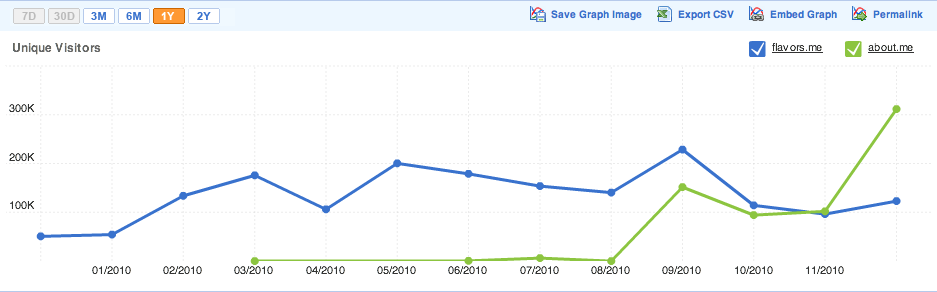
First, let’s take a look at the analytics. Below is the last year run for unique visitors to each site courtesy of http://siteanalytics.compete.com/flavors.me+about.me/)
About.me reached 311,905 uniques in December, the first month it was available to the public. In the months leading up to the release, while in private beta, About.me held anywhere between 66% in September to 94% in November of the uniques Flavors.me received in the same time frame. So why, in Private beta, was About.me able to rival Flavors.me’s open site?
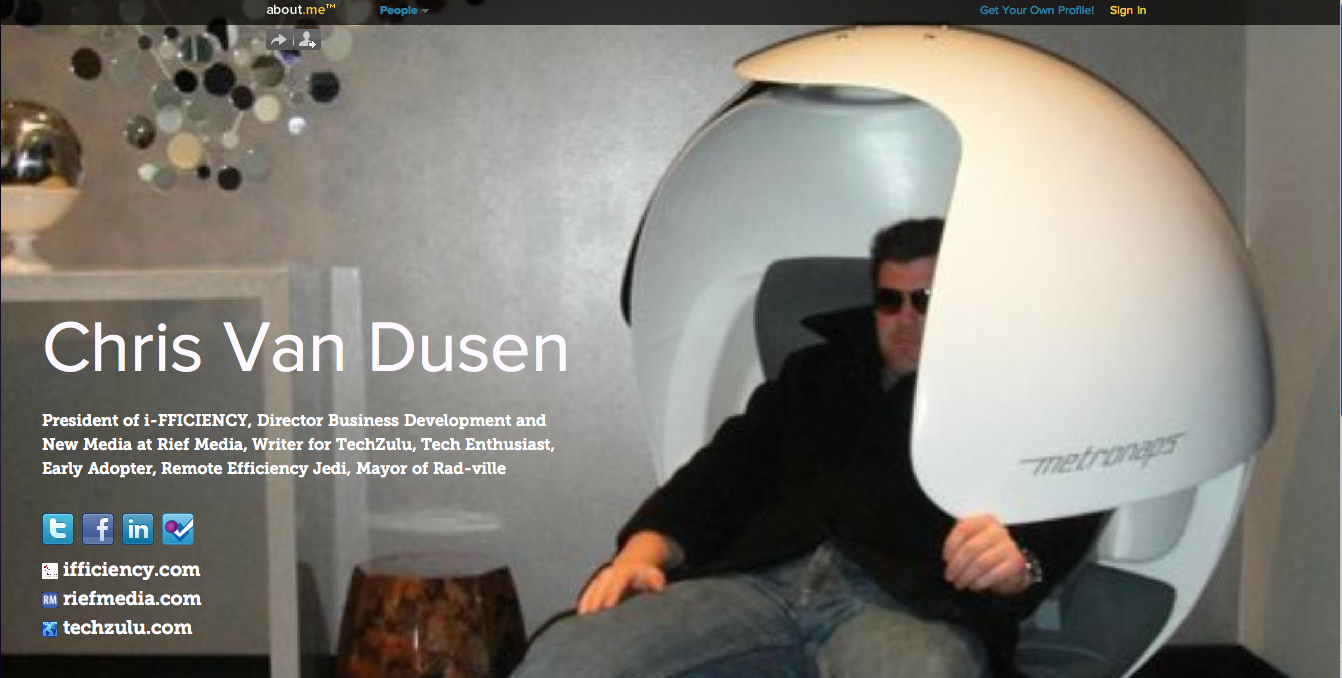
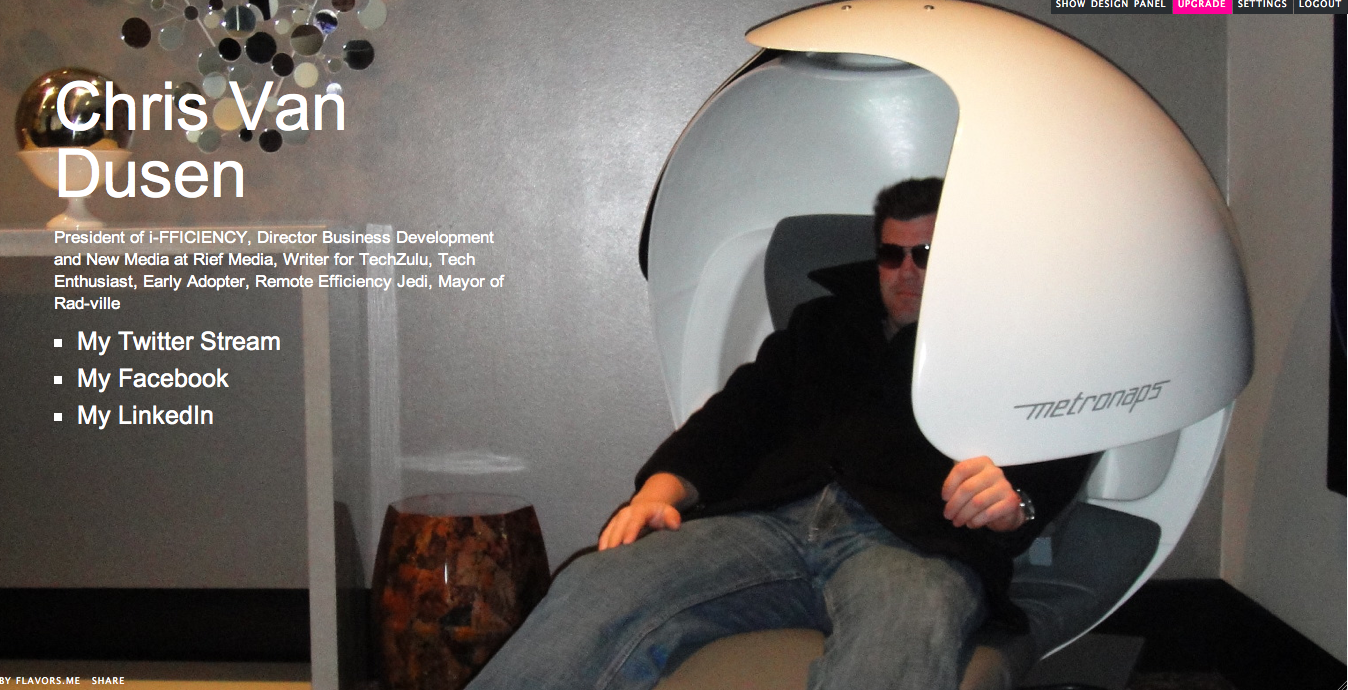
The answer is easy, Flavors.me monetized your ability to be creative. Both sites essentially do the same thing by allowing you to create a custom landing page and tie in all of your social networks. Here are both of my pages for comparison:
While similar which one looks better? In my mind it is the About.me page. It is cleaner, more artistic (relative term for my lack of creativity) and the kicker, it was free. Flavors.me allows for a free but VERY limited page. For $20 a year you get added features like fonts, custom Domain name (mine was taken so I am SOL, damn you Chris Van Dusen children’s book illustrator), and more social networks.
The one benefit that Flavors.me has is from an SEO perspective. Custom domain names and custom Meta Data are features that About.me do not provide (for now). For me though this does not matter. I use my About.me page for one purpose, to make my email signature less cluttered. I wear many hats and have many websites, twitter handles and places to be reached. At the bottom of my signature instead of laying it all out I just add about.me/chrisvandusen. This is also helpful for those with an iPad or iPhone with multiple email addresses. Apple unfortunately has not equipped these devices to have multiple signatures, so adding your About.me profile can help lead different recipients to your networks.
About.me has won this round but it will be interesting to see what AOL will do to ruin this.
Wednesday, January 19, 2011
Bubble Ball game, designed by 14-year-old, knocks Angry Birds off top spot in App Store | Technology | Los Angeles Times
Angry Birds, the hugely popular smart-phone game, has been toppled from its perch by Bubble Ball, a game designed by an eighth-grader.
It's all in a day's work for Utah resident Robert Nay, 14. His puzzle game, with its simple graphics, is riding high in the top spot among the Apple App Store's free games, snatching the position from Angry Birds' Christmas game, known as Seasons.
The standard Angry Birds game still rules the roost among paid apps.
But Nay Games' first offering, launched Dec. 29, has already been downloaded millions of times. Bubble Ball users try to maneuver a ball around the screen by rolling around obstacles and through paths.
According to ABC News, Nay is an avid iPod Touch fan who also plays piano, mandolin and trumpet. But he'll likely focus more of his attentions on his next app, which probably won't be free.
Bubble Ball is also available for Android.
Twitter Launches in Korean
Twitter has just launched the Korean version of its popular service, bringing the total of supported languages to seven.
As is typical for the microblogging company, it made the announcement in Korean. In its blog post, Twitter (
) revealed that it chose Korean as the next language for launch because the number of Twitter users from Korea has increased tenfold in the last year. That’s an astounding growth metric.
Not only is Twitter.com now translated in Korean, but so are the official Twitter Android and iPhone apps. It has also launched a recommended user list of Korean users, including actor Park Joong (@moviejhp) and novelist @Oisoo.
Twitter now supports seven languages. The others include Spanish, Italian, German, French, English and Japanese.
The Incredible Freedom Of A Facebook Engineer
Facebook engineers decide what they want to work on and are allowed to make changes across the site without asking for permission.Skype product Manager Yee Lee talked to a bunch of friends who work at Facebook, and his resulting post on how Facebook ships code makes it sound like the biggest startup in the world. Some of the points in the original post were later corrected on Quora and Reddit, but the overall impression remains the same: Facebook is driven by engineers, not marketers or managers, and they trust each other to do the right thing.
Some of the surprising points:
- Engineers decide what they want to work on. Product managers go around and lobby them trying to convince them to work on their project, then engineers talk to their managers and say "I'd like to work on x this week."
- Engineers handle everything for a particular feature by themselves -- interface design, database access, and so on. If they want help from a specialist, they need to convince them that it's worth their time.
- Engineers are responsible for their own quality assurance testing -- there's no dedicated QA team, although a Test Engineering team does create QA tools for engineers to use.
- Any engineer can check in code to any part of Facebook's code base. Code is reviewed and can be blocked before it's pushed live, however.
- If there's a serious argument about whether to add a feature, Facebook sometimes tests it on a small group of real-world users.
Overall, the ratio of engineers to product managers is between 7 and 10 to 1.
Combine this level of freedom with the prospect of becoming rich when Facebook goes public, and no wonder so many bright people want to work at Facebook -- and that's why older and larger companies like Google are having to pay huge bonuses to keep them from bolting.
Tuesday, January 18, 2011


HTML5 logo unveiled by the World Wide Web Consortium, with help from Microsoft | Technology | Los Angeles Times
HTML5 logo unveiled by the World Wide Web Consortium, with help from Microsoft
January 18, 2011 | 1:36 pm
The World Wide Web Consortium -- also known as the W3C -- released its logo for HTML5 on Tuesday, with the help of Microsoft.
The World Wide Web Consortium is a collaboration of sorts in which corporations including Apple, Google, Microsoft and Opera and nonprofits such as Mozilla contribute to international Internet standards. In all, the W3C has 322 member organizations.
The W3C's HTML5 logo, the group hopes, will be placed on websites built using HTML5, the programming language and technologies that are still in development but becoming an increasingly popular standard for the Web.
The logo, an angular orange shield, was designed by the W3C with input from Microsoft. And Microsoft is already helping to promote the logo's use.
Jean Paoli, Microsoft's general manager of interoperability, wrote in a blog post that "the logo links back to W3C, the place for authoritative information on HTML5, including specs and test cases. It's time to tell the world that HTML5 is ready to be adopted."
The logo can be downloaded and used or tweaked by anyone as he or she sees fit, under a Creative Commons license.
The W3C is giving away HTML5 logo stickers and selling logo t-shirts that read, "I've seen the future. It's in my browser."
"It stands strong and true, resilient and universal as the markup you write," the W3C wrote in introducing the logo. "It shines as bright and as bold as the forward-thinking, dedicated web developers you are. It's the standard's standard, a pennant for progress. And it certainly doesn't use tables for layout."