By SAM SCHECHNER And JESSICA E. VASCELLARO
Just as the digital wave transforms the television industry, Hulu, a pioneer of Internet TV, is in internal discussions to dramatically transform itself.
The free online television service has become one of the most-watched online video properties in the U.S. and a top earner of web-video ad dollars since its 2008 launch.
WSJ's Sam Schechner reports on Hulu re-tooling its business plan to keep up with a changing digital world.
But its owners—industry powerhouses NBC Universal, News Corp. and Walt Disney Co.—are increasingly at odds over Hulu's business model. Worried that free Web versions of their biggest TV shows are eating into their traditional business, the owners disagree among themselves, and with Hulu management, on how much of their content should be free.
Fox Broadcasting owner News Corp. and ABC owner Disney are contemplating pulling some free content from Hulu, say people familiar with the matter. The media companies are also moving to sell more programs to Hulu competitors that deliver television over the Internet, including Netflix Inc., Microsoft Corp. and Apple Inc.
And in what would be a major shift in direction, Hulu management has discussed recasting Hulu as an online cable operator that would use the Web to send live TV channels and video-on-demand content to subscribers, say people familiar with the talks. The new service, which is still under discussion, would mimic the bundles of channels now sold by cable and satellite operators, the people said.
![[HULU_p1]](http://si.wsj.net/public/resources/images/P1-AZ222A_HULU__NS_20110126182113.jpg)
Hulu's managers say tumult is natural in such a fast-changing industry. "When we blaze trails, which is what Hulu is about, it takes time," said Jason Kilar, Hulu's chief executive, in an interview. "That is not for the faint of heart, and we understand that."
When it launched three years ago, Hulu was the networks' answer to Google Inc.'s video-sharing site YouTube. It provided an easy—and legal—way for viewers to watch new TV shows online whenever they wanted for free. It now offers more than 30,000 television episodes, and its new Hulu Plus subscription service lets users watch on Internet-connected TVs and portable devices like the iPad.
But the digital landscape is changing so fast that Hulu's future is unclear. The networks are grappling with a dilemma facing all entertainment companies: how soon to release movies or shows online without destroying their value in other lucrative "windows" such as DVDS or reruns on cable TV—and at what price.
After upending the music and publishing industries, the digital revolution is poised to shake up TV in earnest this year. As more viewers watch TV and movies on the Internet, industry executives say a generation of TV watchers may never sign up for cable or satellite television, turning off the spigot of monthly fees that have helped support TV for over 30 years. Broadcasters such as those behind Hulu, cable TV operators, and even TV hardware makers such as Sony Electronics are scrambling to figure out their role in the new Internet television universe.
The number of U.S. households that pay for TV service from cable, satellite or phone companies dipped for the first time last year after decades of growth, with 335,000 fewer households paying for service between the first and the third quarters, according to research firm SNL Kagan.
Hulu.comHulu's owners are worried that free Web versions of their biggest TV shows are eating into their traditional business. Hulu has launched a new paid service, Hulu Plus.
In last year's fourth quarter, the number of people between ages 18 and 49 watching any kind of TV on a traditional set was down about 1.3% from the previous fall, according to Nielsen Co, the biggest decline in at least four years.
At the same time, Internet viewing has increased. U.S. consumers watched about three billion videos on websites offering TV shows in December, up 96% from a year earlier, according to comScore Inc. Hulu alone saw the number of videos it showed double in that period.
Hulu's owners all agree that "consumer behavior is changing" toward more time on Internet-connected devices, said Mr. Kilar. "If you're a content owner, you're at risk of being left behind."
![[HULU_jmp]](http://si.wsj.net/public/resources/images/P1-AZ236_HULU_j_NS_20110126182120.jpg)
But they can't agree on the best way to capture the new audience.
"It remains unclear what the business model is" for Hulu, said Bruce Rosenblum, head of the television arm of Time Warner Inc.'s Warner Bros. studio. "At some point, if enough people turn off cable, then you've got a complete disruption of the business model," he said.
When Hulu was created in 2007, NBC Universal and News Corp.—which also owns The Wall Street Journal—were concerned about the growing influence of YouTube and pirated copies of their programs showing up on the Internet. Hulu aggregated the networks' TV shows online and made money by selling advertising.
The partners hired Mr. Kilar, former general manager of Amazon.com Inc.'s North American media business, giving him autonomy to chart a new course. Mr. Kilar, 39, was determined to create an independent corporate culture closer to the tech world than the tradition-bound television business.
The company built a Silicon Valley-inspired startup in a low-slung office park in Santa Monica, a few miles west of its Hollywood owners. In the break room, engineers modified a refrigerator to house a beer keg, cutting a hole in it to fit a special tap in the shape of Hulu's logo.
Mr. Kilar gave new hires a culture manifesto, an 1,100-word document that paints Hulu as a frugal meritocracy where "Fruity Snacks boxes hold up our monitors," but where everyone has a "neurotic focus on quality."
In an office expansion, Mr. Kilar and senior managers gave up their offices to sit at desks in an open floor plan among hundreds of employees, underscoring Hulu's egalitarian approach.
It wasn't long before the new venture clashed with owners' established ways.
Hulu competitor Netflix also charges a monthly fee.
In 2008, ad-sales executives at both Fox and NBC complained to their bosses that Hulu was cutting into sales on the networks' own websites like Fox.com or NBC.com.
The protests fell on deaf ears. News Corp.'s then-president and chief operating officer, Peter Chernin, and NBC Universal's Chief Executive Jeffrey Zucker defended Hulu as part of a larger strategy to build their online business.
The strategy drew viewers. A slick commercial in the February 2009 Super Bowl jokingly revealed Hulu as an extra-terrestrial plot to turn human brains to mush from excessive TV consumption. Hulu's traffic skyrocketed, reaching 397 million U.S. video views in April, up 58% from January, according to comScore.
Mr. Kilar needed more content to show all his new customers. Hulu turned to Disney, offering the entertainment giant an equity stake in return for access to ABC programming. After months of wooing by Messrs. Chernin, Zucker and Kilar, Disney came on board in the summer of 2009. The company provided two years of exclusive access to TV shows—including "Grey's Anatomy" and "Lost"—on the Web free with advertisements.
Soon, the stage was set for a showdown. News Corp. had announced that Mr. Chernin, an original creator of Hulu, would leave the company at the end of June. News Corp. named Chase Carey to be its new president and chief operating officer.
Mr. Carey had a very different vision for Hulu, according to people familiar with the matter. The former head of satellite operator DirecTV, Mr. Carey was a big believer in the subscription-TV business. He worried that online video would train a generation of people to expect entertainment for free with advertising. He thought Hulu should be supported by both subscriptions and ads, those people said.
The strategy conflicted with Hulu's initial business model. While Mr. Kilar had talked about adding subscriptions since Hulu's launch, people close to him say he thought the best way to build the business was to increase the audience by keeping much of the content free, supported by advertising.
Editors' Deep Dive: Video Providers Revise Fee Models
DOW JONES NEWS SERVICE
Amazon Buys Full Control of LoveFilm
Dow Jones News Service
Hulu Considers More Pay Plans
Dow Jones Business News
Sony Draws on Music Lessons for Video
Access thousands of business sources not available on the free web. Learn MoreAmong broadcast networks, pressure was building to increase revenue. Having seen their audience migrate to cable for years, the networks were becoming increasingly insistent about seeking monthly fees from cable and satellite operators who used their broadcast signals. The networks needed the fees to help pay for soaring production and sports-rights costs. But in tense negotiations, the cable and satellite operators had a big objection: Why would we pay you for content you make available free on the Web?
In 2009, Mr. Kilar hashed out a subscription model that would become Hulu Plus. The idea was a compromise: New TV shows would remain free with ads. Paying subscribers would be offered additional content, as well as the ability to watch Hulu on devices other than their computers.
At a meeting of Hulu owners at News Corp.'s Manhattan headquarters last April, Hulu's management said it wanted Hulu Plus to offer access on multiple devices to full seasons of shows like ABC's "Desperate Housewives," leaving the most-recent episodes free with ads.
Some attendees said that didn't go far enough. At one point, Peter Levinsohn, head of digital distribution for Fox Filmed Entertainment, contended the new paid service was not differentiated enough from the existing free one, according to people familiar with the meeting.
Andy Forssell, Hulu's head of content acquisition and distribution, replied that Hulu would lose advertising if it restricted access to free new episodes.
Despite its privileged access to content, Hulu's revenue is still small compared to the bigger TV ecosystem and emerging competitors such as Netflix. In 2010, Hulu reported revenue of more than $260 million, up from $108 million in 2009. Netflix, which also rents out DVDs, had revenue of $2.16 billion last year.
Hulu's management prevailed that time. But owners and management would continue to differ on strategy.
In April, Disney unveiled software for Apple's new iPad tablet computer, offering free access to some ABC television shows with advertisements. The service raised a conflict: Hulu already was planning to offer the paid Hulu Plus service on the iPad.
Some Hulu board members and staffers were stunned. Mr. Kilar called Disney's chief executive, Robert Iger, to express concern, say people briefed on the call.
By last summer, eager to raise money to secure more content, Hulu management began discussing the idea of an initial public offering.
Hulu managers flew to New York in August to talk to investment bankers, some of whom estimated the company could go public at a valuation of around $2 billion. But to get such a handsome number, Hulu would need to lock up long-term access to its owners' programming.
The owners, however, wanted to first nail down their own new license deals with Hulu, which are set to expire this summer. They didn't want to conduct those negotiations while Hulu was under pressure to impress markets.
Board members, including Mr. Kilar, tabled the IPO in the fall and are now discussing raising capital through other methods. Hulu has asked the owners to invest more themselves, say people familiar with the matter, although it's unclear whether they will do so.
By October, as Hulu Plus was about to launch to a wide audience, Mr. Kilar clashed again with the owners.
Hulu's CEO worried that rival video service Netflix was gaining traction with a feature that allowed subscribers to stream movies and TV shows online on demand. Mr. Kilar proposed dropping Hulu Plus's monthly subscription rate to $4.99 from $9.99.
In a conference call, Mr. Kilar told the media executives how critical his proposals were: He indicated he was prepared to leave when his contract expired if owners didn't follow his recommendations, according to people familiar with the matter.
Both sides eventually compromised, and the owners agreed to a smaller 20% cut to $7.99 a month.
Hulu's owners are now preparing to start negotiations for their new licenses. Discussions have included such concerns as whether giving Hulu exclusive content restricts the owners unnecessarily. News Corp. and Disney are also each mulling whether to wait two weeks or more after a TV episode airs before making it available free online, according to people familiar with the matter.
Meanwhile, the media companies have all struck deals to license TV shows to Hulu's competitor, Netflix.
When NBC Universal recently gave new episodes of "Saturday Night Live" to Netflix, Mr. Kilar complained in a phone call with NBC's Mr. Zucker, people briefed on the conversation said.
NBC Universal is being forced to relinquish its Hulu management rights as part of government conditions on its takeover by Comcast Corp. NBC Universal may be obliged to start making more deals with Hulu competitors as part of those conditions.
ABC, for its part, has quietly built a potential subscription-based service that could mirror the selection of ABC shows in Hulu's subscription offering, according to people familiar with the plans. It remains unclear if it will launch the service.
Hulu's owners are now considering management's proposal to create a "virtual cable operator," according to people familiar with the talks. If they decide to move forward, some form of Hulu's free service would likely remain under such a plan. It is possible Hulu Plus could be folded into the new service, one of the people said.
Write to Sam Schechner at sam.schechner@wsj.com and Jessica E. Vascellaro at jessica.vascellaro@wsj.com
Thursday, January 27, 2011
Hulu Reworks Its Script as Digital Change Hits TV


Wednesday, January 26, 2011
Consumers confused by Web TV programming choices, says NATPE - FierceCable
Rather than enriching and exciting viewers, the blend of Web and traditional TV programming is going to confound them for a while, executives at the National Association of Television Program Executives (NATPE) said during that organization's meeting.
"With all this digital technology there's still consumer confusion ... and if the consumer is confused, none of it's going to work," said Nick Buzzell, an NBTV Studios producer.
It will sort out as soon as the television networks understand the model and consumers become comfortable with it, said Ted Sarandos, Netflix (Nasdaq: NFLX) chief content officer, who said that Netflix is "not centered around last night's episode. It's all about the history of the show." A single episode can offer a taste of the feast that is a show's whole season, he said.
Thus far, Netflix has had a tough time convincing programmers that the model will work. "We offered HBO a huge amount of money, a huge amount of money, for hit vampire drama ‘True Blood' and they wouldn't sell it to us. I should say, they haven't sold it to us yet."
Monday, January 24, 2011
Google Chrome, Mozilla Firefox announce tools to block Web tracking by advertisers | Technology | Los Angeles Times
January 24, 2011 | 11:37 am
Google's Chrome and Mozilla's Firefox Web browsers are each gaining new features that will block advertisers from tracking Web surfing habits.
Firefox's feature, announced Sunday, will be called Do Not Track and is under development. Chrome's utility, announced Monday, is called Keep My Opt-Outs and available now.
The two tools to help protect user privacy follow a December Federal Trade Commission recommendation that all Web browsers add do not track features.
Shortly after the FTC recommendation, Microsoft said its upcoming Internet Explorer 9 will have a feature that will enable users to create lists of websites they do or do not want tracking them.
Alex Fowler, Mozilla's technology and privacy officer, said in a blog post that Firefox's upcoming Do Not Track feature will be the nonprofit group's first step toward improving user privacy.
"When the feature is enabled and users turn it on, web sites will be told by Firefox that a user would like to opt-out of OBA [online behavioral advertising]," Fowler wrote. "We believe the header-based approach has the potential to be better for the web in the long run because it is a clearer and more universal opt-out mechanism than cookies or blacklists."
Google too announced its blocking tool in a blog post.
Sean Harvey and Rajas Moonka, two Google product managers, wrote that Keep My Opt-Outs will allow users to opt out of tracking from advertisers by way of a downloadable browser extension that will allow users to defer from personalized ads "from all participating ad networks only once and store that setting permanently."
Both Google and Mozilla's tracking blocking tools do, however, have a caveat.
The tools only apply to advertising companies that offer opt-out options. So far, advertisers have been slow to add such options themselves, though Google noted that the advertisers that are members of the Network Advertising Initiative offer such options, as do some Web advertising trade associations.
Web advertisers track which websites consumers visit online in large part to offer Web ads that would appeal to a user based on the user's surfing habits.
Google said once its Keep My Opt-Outs feature could lead to users seeing repeat ads or ads that are less relevant to their interests. Google, a major seller of Web advertising, also offers the option of users tailoring ads they see in Chrome by telling the Mountain View-based company what types of ads they'd like to see.

Sunday, January 23, 2011
Article: 31 New Social Media Resources You May Have Missed
http://mashable.com/2011/01/22/new-social-media-resources-16/
Friday, January 21, 2011
Things Real People Don't Say About Advertising
Thursday, January 20, 2011
Flavors.me Vs About.me | Splash Page Supremacy | TechZulu
The battle for splash page supremacy carries on although no one told Flavors.me they have already lost. I recently wrote an article explaining how About.me sold out to AOL. I shared that in my opinion the ‘Thrill is gone’. With AOL buying the startup who knows what direction it would ultimately take. My sentiment remains unchanged, however, after noodling around on the flavors.me page and setting up a profile I now realize why About.me was acquired and not Flavors.me.
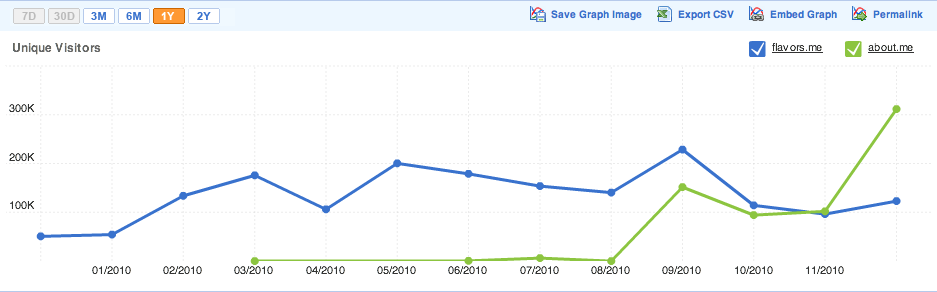
First, let’s take a look at the analytics. Below is the last year run for unique visitors to each site courtesy of http://siteanalytics.compete.com/flavors.me+about.me/)
About.me reached 311,905 uniques in December, the first month it was available to the public. In the months leading up to the release, while in private beta, About.me held anywhere between 66% in September to 94% in November of the uniques Flavors.me received in the same time frame. So why, in Private beta, was About.me able to rival Flavors.me’s open site?
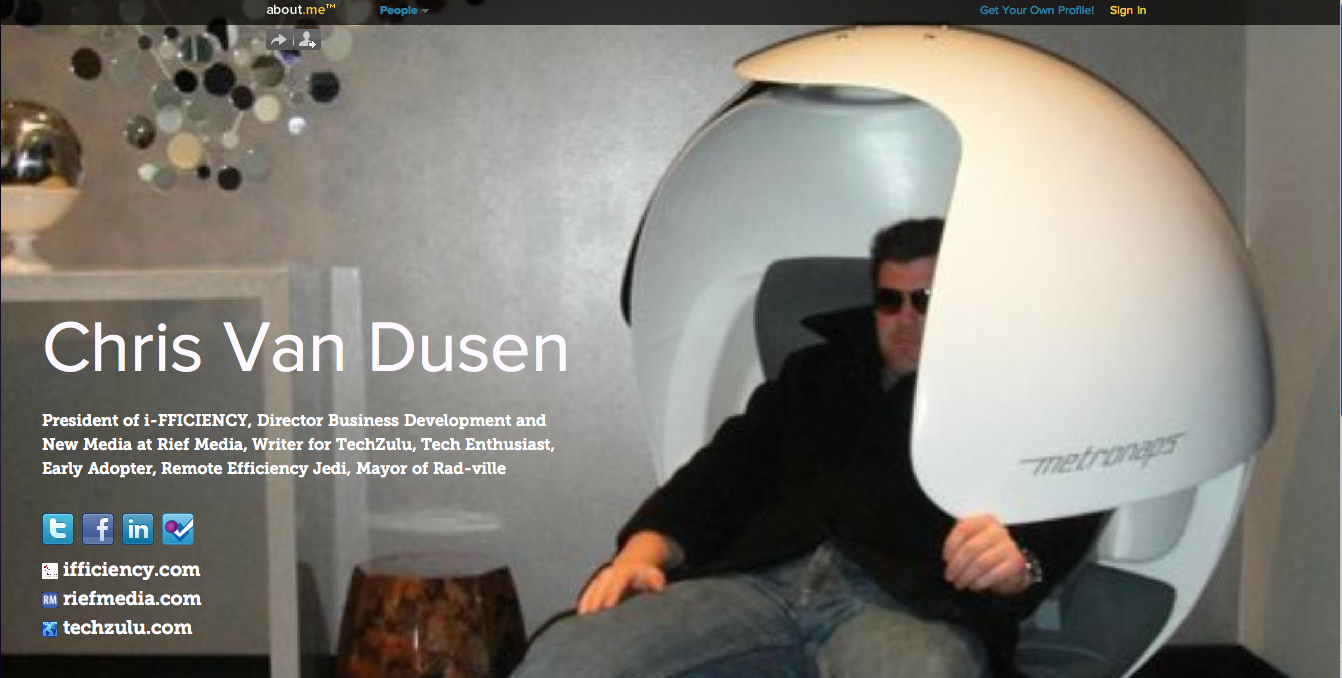
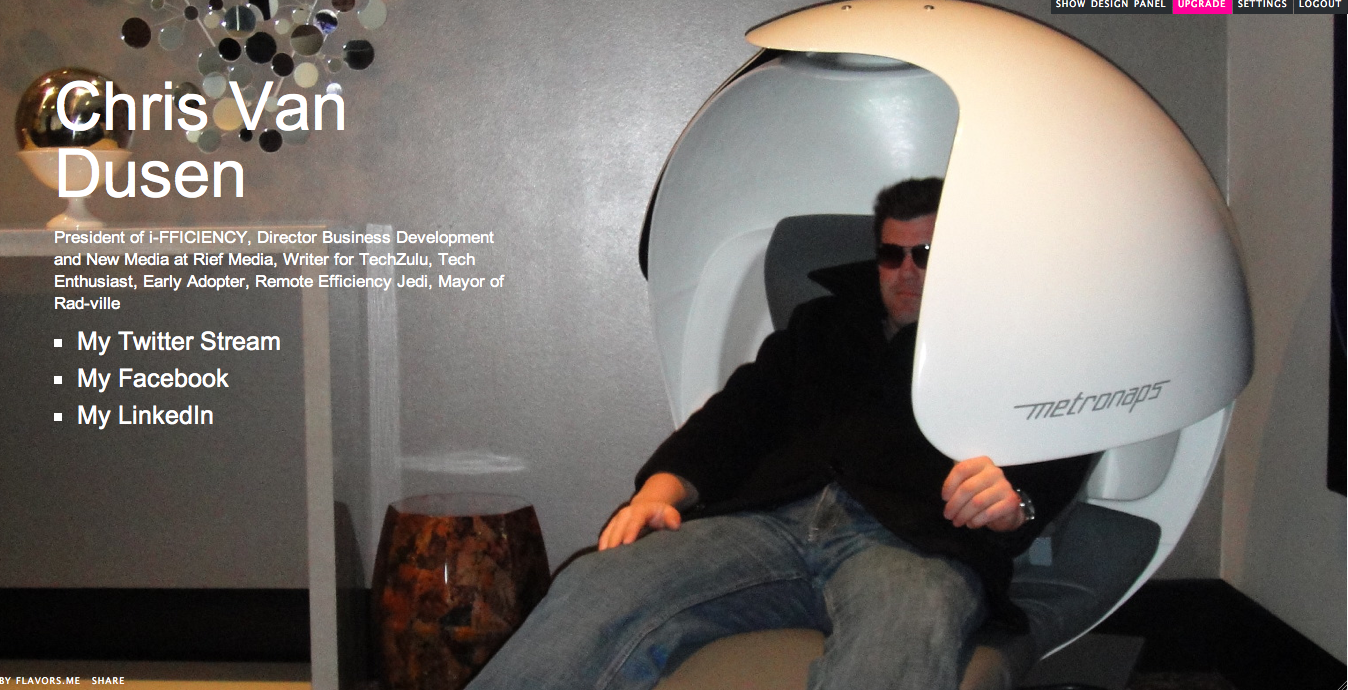
The answer is easy, Flavors.me monetized your ability to be creative. Both sites essentially do the same thing by allowing you to create a custom landing page and tie in all of your social networks. Here are both of my pages for comparison:
While similar which one looks better? In my mind it is the About.me page. It is cleaner, more artistic (relative term for my lack of creativity) and the kicker, it was free. Flavors.me allows for a free but VERY limited page. For $20 a year you get added features like fonts, custom Domain name (mine was taken so I am SOL, damn you Chris Van Dusen children’s book illustrator), and more social networks.
The one benefit that Flavors.me has is from an SEO perspective. Custom domain names and custom Meta Data are features that About.me do not provide (for now). For me though this does not matter. I use my About.me page for one purpose, to make my email signature less cluttered. I wear many hats and have many websites, twitter handles and places to be reached. At the bottom of my signature instead of laying it all out I just add about.me/chrisvandusen. This is also helpful for those with an iPad or iPhone with multiple email addresses. Apple unfortunately has not equipped these devices to have multiple signatures, so adding your About.me profile can help lead different recipients to your networks.
About.me has won this round but it will be interesting to see what AOL will do to ruin this.
Wednesday, January 19, 2011
Bubble Ball game, designed by 14-year-old, knocks Angry Birds off top spot in App Store | Technology | Los Angeles Times
Angry Birds, the hugely popular smart-phone game, has been toppled from its perch by Bubble Ball, a game designed by an eighth-grader.
It's all in a day's work for Utah resident Robert Nay, 14. His puzzle game, with its simple graphics, is riding high in the top spot among the Apple App Store's free games, snatching the position from Angry Birds' Christmas game, known as Seasons.
The standard Angry Birds game still rules the roost among paid apps.
But Nay Games' first offering, launched Dec. 29, has already been downloaded millions of times. Bubble Ball users try to maneuver a ball around the screen by rolling around obstacles and through paths.
According to ABC News, Nay is an avid iPod Touch fan who also plays piano, mandolin and trumpet. But he'll likely focus more of his attentions on his next app, which probably won't be free.
Bubble Ball is also available for Android.
Twitter Launches in Korean
Twitter has just launched the Korean version of its popular service, bringing the total of supported languages to seven.
As is typical for the microblogging company, it made the announcement in Korean. In its blog post, Twitter (
) revealed that it chose Korean as the next language for launch because the number of Twitter users from Korea has increased tenfold in the last year. That’s an astounding growth metric.
Not only is Twitter.com now translated in Korean, but so are the official Twitter Android and iPhone apps. It has also launched a recommended user list of Korean users, including actor Park Joong (@moviejhp) and novelist @Oisoo.
Twitter now supports seven languages. The others include Spanish, Italian, German, French, English and Japanese.
The Incredible Freedom Of A Facebook Engineer
Facebook engineers decide what they want to work on and are allowed to make changes across the site without asking for permission.Skype product Manager Yee Lee talked to a bunch of friends who work at Facebook, and his resulting post on how Facebook ships code makes it sound like the biggest startup in the world. Some of the points in the original post were later corrected on Quora and Reddit, but the overall impression remains the same: Facebook is driven by engineers, not marketers or managers, and they trust each other to do the right thing.
Some of the surprising points:
- Engineers decide what they want to work on. Product managers go around and lobby them trying to convince them to work on their project, then engineers talk to their managers and say "I'd like to work on x this week."
- Engineers handle everything for a particular feature by themselves -- interface design, database access, and so on. If they want help from a specialist, they need to convince them that it's worth their time.
- Engineers are responsible for their own quality assurance testing -- there's no dedicated QA team, although a Test Engineering team does create QA tools for engineers to use.
- Any engineer can check in code to any part of Facebook's code base. Code is reviewed and can be blocked before it's pushed live, however.
- If there's a serious argument about whether to add a feature, Facebook sometimes tests it on a small group of real-world users.
Overall, the ratio of engineers to product managers is between 7 and 10 to 1.
Combine this level of freedom with the prospect of becoming rich when Facebook goes public, and no wonder so many bright people want to work at Facebook -- and that's why older and larger companies like Google are having to pay huge bonuses to keep them from bolting.
Tuesday, January 18, 2011


HTML5 logo unveiled by the World Wide Web Consortium, with help from Microsoft | Technology | Los Angeles Times
HTML5 logo unveiled by the World Wide Web Consortium, with help from Microsoft
January 18, 2011 | 1:36 pm
The World Wide Web Consortium -- also known as the W3C -- released its logo for HTML5 on Tuesday, with the help of Microsoft.
The World Wide Web Consortium is a collaboration of sorts in which corporations including Apple, Google, Microsoft and Opera and nonprofits such as Mozilla contribute to international Internet standards. In all, the W3C has 322 member organizations.
The W3C's HTML5 logo, the group hopes, will be placed on websites built using HTML5, the programming language and technologies that are still in development but becoming an increasingly popular standard for the Web.
The logo, an angular orange shield, was designed by the W3C with input from Microsoft. And Microsoft is already helping to promote the logo's use.
Jean Paoli, Microsoft's general manager of interoperability, wrote in a blog post that "the logo links back to W3C, the place for authoritative information on HTML5, including specs and test cases. It's time to tell the world that HTML5 is ready to be adopted."
The logo can be downloaded and used or tweaked by anyone as he or she sees fit, under a Creative Commons license.
The W3C is giving away HTML5 logo stickers and selling logo t-shirts that read, "I've seen the future. It's in my browser."
"It stands strong and true, resilient and universal as the markup you write," the W3C wrote in introducing the logo. "It shines as bright and as bold as the forward-thinking, dedicated web developers you are. It's the standard's standard, a pennant for progress. And it certainly doesn't use tables for layout."
Monday, January 10, 2011
HuffPo Readers Dislike “Connect With Facebook” Feature
HuffPo Readers Dislike “Connect With Facebook” Feature
Reader of the Huffington Post are not happy with the news blog’s ”Connect With Facebook” feature that allows the site to recommend articles based on your Facebook profile.

It seemed like a cool, practical, rather natural idea: Have those Huffington Post readers who are also Facebook users to connect via the latter so that the Post could pick up on your interests and “likes” and recommend articles accordingly. But readers haven’t received this new feature with open arms.
“I don’t want any such ‘recommendation’ feature to channel me away from stories or presume that my interests don’t shift,” wrote MyFatCat. “This might be good for your advertisers, but it’s bad for my reasons for coming here.”
A few other commenters echoed this reasoning, hinting that Huff Post readers generally consider themselves fairly well educated and read, and don’t really need stories to be “so intensely personalised” and “babyfed,” as Leviathan21 put it. “I think I’m capable of navigating my way around a website and clicking on articles that interest me. I don’t need someone to pick my articles for me,” he added.
Cdub1991 said that the move was “a rather obvious ploy to increase revenue by enhancing their ability to sell targeted marketing to their advertising clients. I wish them well, but I think I’ll pass.”
Given that the Huffington Post encouraged users to voice their feedback about the new feature, it seems like the media team has a lot of thinking to do. Then again, people usually meet changes within their online communities with a lot of resistance, as we see here every time Facebook launches a new layout or adds a new feature.
Friday, January 7, 2011

Wednesday, January 5, 2011
Untitled
Drupal 7.0 Now Available!
January 5, 2011After nearly three years of development, Drupal 7.0 is officially available. The latest release of the open source content management system that powers high profile websites like WhiteHouse.gov features a revamped admin interface, more flexibility options for content and more optimized code.
Drupal founder and project leader Dries Buytaert estimates that approximately 1,000 people contributed to Drupal 7. The Drupal community at large will be holding worldwide “release parties” in 88 countries on Friday, January 7, 2011.
Mashable recently named Drupal one of the 10 websites to watch in 2011, in large part because of the improvements promised by Drupal 7. The CMS already powers approximately 1% of all the websites in world and we expect to see that figure only increase.Drupal has always been well regarded in terms of its power and abilities; it’s just actually learning and using the system that can take more effort. That’s why one of the big undertakings with Drupal 7 (and something that will continue to be a focus in Drupal 8) is in usability, especially from an administration perspective.
The installation process has also received an overhaul — and Drupal might not quite match WordPress’s famous “five-minute install” on live hosting environments — but on a local host, the process is just as simple.
The default installation includes built-in modules for things like OpenID support, forums and contact forms that you can enable or disable at will.
Check out this video the Drupal team put together showing off all of the hard work that has gone into Drupal 7.0.
via mashable.com
Tuesday, January 4, 2011
Griffin Technology: CarTrip - OBD-II Hardware Interface
Interface with your car's on-board computer
Your car has a lot more to say than just what its "Check Engine" light can tell you. CarTrip makes you a better listener.
If your car was built anytime after 1996, you can plug into its on-board computer and access a staggering array of diagnostic and performance information. That's been great news for tuners and shade-tree mechanics everywhere. But other than the mysterious and seemingly arbitrary "Check Engine" light, there hasn't been an easy way to make that data available to the average driver.
Until now.
Griffin's CarTrip On-Board Diagnostic Computer Reader is the easy, fun tool that helps you drive more fuel efficiently, save money, and do your part to save the planet.
CarTrip's wireless monitor plugs into your car's OBD-II port to record and analyze data from your car's on-board computer, then displays it on your compatible smartphone using a friendly (and free) little app called CleanDrive.
CleanDrive monitors your car's performance, collecting data like fuel consumption, acceleration, top speed and engine diagnostic codes as you drive. CleanDrive crunches the numbers and displays your "Carbon Score" in an easy-to-understand format on your device's screen. Instantaneous trip and long-term averages are recorded to give you a clear picture of how your driving habits impact the environment and the efficiency of your car over time.
In addition, CleanDrive will display and reset the diagnostic codes sent by your car's on-board computer, so you can know what the "Check Engine" light is really saying.
Your car's computer has a world of information to share that can help you maintain your car and become a better driver. CarTrip by Griffin tells you how.
U.S. Views More TV and Continues Shift to Cable
Countless shows were about cops and robbers, too, and countless hours were devoted to competitive singing, dancing and even figure skating, and they each found an audience, proving again that television remains a refuge in the media revolution. (Except, perhaps, for figure skating. In December, ABC’s “Skating With the Stars” struggled to keep a mere one million viewers ages 18 to 49.)
Americans watched more television than ever in 2010, according to the Nielsen Company. Total viewing of broadcast networks and basic cable channels rose about 1 percent for the year, to an average of 34 hours per person per week. The generation-long shift to cable from broadcast continued, but subtly, as the smallest of the big four broadcast networks, NBC, still retained more than twice as many viewers as the largest basic cable channel, USA.
Cable hits like “Jersey Shore” on MTV and “The Walking Dead” on AMC were showered with media attention and affection, but the most popular new show was CBS’s “Hawaii Five-0,” a revival of a 40-year-old drama.
CBS, stable as always, was the No. 1 network among total viewers for 51 out of 52 weeks, and three of its new shows, “Hawaii Five-0,” “Blue Bloods” and “Mike & Molly,” landed in the top 20 for the year, the only new shows to do so. CBS also used the Super Bowl to introduce the reality show “Undercover Boss,” which cracked the top 25.
“CBS has been able to replenish its lineup as older shows fade,” said Brad Adgate, the senior vice president for research at Horizon Media. He contrasted CBS with ABC, which bid adieu to “Lost” in May and seeded no new hits since.
Among viewers ages 18 to 49, Fox again ranked first for the year, with a 3.0 rating on average, in part because of “American Idol” and one of the breakout hits of 2009, “Glee.”
Nielsen noted in an end-of-the-year recap that eight of the 10 highest-rated telecasts of the year were football games. The two others were the Academy Awards and the premiere of “Undercover Boss,” which followed the Super Bowl.
The biggest gainer on the broadcast ledger was a Spanish-language player, Univision, which is drawing more attention for its ratings victories. For the year it averaged a 1.5 rating among 18- to 49-year-olds and 3.7 million total viewers. On an otherwise quiet Monday last week, the finale of one of its telenovelas, “Soy Tu Dueña,” or “I’m Your Owner,” averaged four million viewers in that demographic, beating all the English-language networks for the night.
On cable, USA remained the most popular in prime time. Despite some signs of audience erosion, its C.I.A. drama, “Covert Affairs,” was the most popular nonsports program on cable among younger viewers, beating some new dramas on the broadcast networks. USA’s rival TNT had a breakout hit in “Rizzoli & Isles,” an opposites-attract crime-solving show.
Despite a vast oil spill and a midterm election, all of the cable news channels posted declines from 2009. The Fox News Channel remained the most popular of the group by far. MSNBC celebrated a historic win in prime time over CNN, having beaten that channel for the first time among all viewers. (In 2009, it beat CNN for the first time among 25- to 54-year-olds.)
The bad news for CNN did not end there. It lost more viewers than any other cable channel, according to Mr. Adgate’s research, ending the year with an average of 578,000 viewers in prime time, down 34 percent from a 2009 average of 874,000 viewers. Two other channels, VH1 and the Hallmark Channel, also lost more than a quarter of their audience.
The History Channel and Ion Television each grew by more than 25 percent year-over-year. History was helped by “Pawn Stars” and “American Pickers,” trash-into-treasure reality shows that spawned imitators on other channels.
TLC now has “Pawn Queens,” Discovery now has “Auction Kings,” Spike now has “Auction Hunters,” and A&E now has “Storage Wars.” Spike, which had a tough year, went so far as to brag in a December news release that “Auction Hunters” had been beating “Auction Kings”; both shows have been renewed.
Perhaps the most eye-popping growth on television came from the relatively small Investigation Discovery, or I.D., which specializes in nonfiction crime stories and is owned by Discovery Communications. I.D. averaged 283,000 viewers at any given time, a gain of 64 percent over the previous year.
I.D. did it by bulking up on repeatable shows like “On the Case With Paula Zahn,” hosted by the former CNN anchor, and “Who the (Bleep) Did I Marry,” about crimes that ruin relationships.
A perfect cup of coffee?
Does the perfect cup of coffee exist? Only your nose knows. Among coffee connoisseurs, perfection is often defined as coffee that tastes as good as it smells. The experts at Intelligentsia Coffee & Tea say these simple tips can help you brew a truly great cup of coffee.
1. Use the best beans. Coffee is ranked on a hundred-point scale. According to industry experts, only coffee that scores 80 points or higher deserves to be rated as "specialty coffee," and only coffee that scores 90 points or more can be classified as "outstanding." You can check out Coffee Review for a list of high-scoring coffees in your area.
2. Grind it yourself: Coffee's flavor comes from natural oils trapped inside the bean during the roasting process. Once coffee is ground up, those oils begin to dissipate. So if you grind your coffee the night before to save time, you're actually getting a less flavorful cup. Most professionals use a burr grinder, which allows for a more consistent grind.
3. Pre-wet your filter: If you're using a filter-based method to brew your coffee, make sure to pre-wet it with hot water before adding the dry grinds. All manufactured paper products have a thin layer of dust. Pre-wetting washes away that dust so it doesn't end up in your coffee. (Just make sure to empty out that water before you start the actual coffee-making process!)
4. Timing is everything: Each method of making coffee has a precise brew time; letting your coffee brew too long allows the hot water to extract too much oil from the ground-up bean, creating a bitter brew. Too short a brew time and you get a thin, flavorless beverage. Total brew time for most methods is 3 ½ to 4 minutes.
5. Let it cool and leave it alone: Coffee is a hot drink, but allowing it to cool slightly will reveal the true flavor of the beverage. And as for all that milk and sugar? Save it for dessert. Really great coffee doesn't need anything to enhance its distinct flavor.
6. Moderation is essential: Caffeine is one of the primary reasons people drink coffee, but according to Kyle Glanville at Intelligentsia, caffeine is a natural poison -- the coffee tree's defense mechanism against predators. When a person drinks too much coffee, it begins to taste bitter. That's your body politely telling you to please stop poisoning yourself.
The folks at Intelligentsia would be the first to say that they haven't yet discovered the perfect cup of coffee -- the one that truly mimics the amazing aroma experienced when you stick your nose in a bag of fresh-roasted coffee beans. But they sure have fun trying.
If you want the specifics of how to make a great cup of coffee at home, they have a great mobile app with step-by-step directions for all methods, and even a brew timer. As for me? I'm going to kick back, relax, and have another cup of truly great coffee.

Mm.. Coffee - and how to make good Coffee
Monday, January 3, 2011
9 Reasons Why Your Social Media Strategy Isn’t Working
9 Reasons Why Your Social Media Strategy Isn’t Working
January 3, 2011Social media is the hottest way businesses are reaching out to potential customers. When executed correctly, a social media marketing campaign can bring traffic to your website and generate new leads for your sales team. And there are so many options, from Facebook, to Twitter, to LinkedIn, to YouTube, and the list goes on and on. To many, social media can seem like an overwhelming black hole of time with no end in sight. If this feeling sounds familiar to you, here are some reasons why your social media strategy might not be working for your business.
1. Your social channels are overly self-promotional
If you’re only sharing self-promotional content on your social media profiles, people aren’t going to want to follow you. People will want to follow you because they think your updates are interesting. “Interesting” doesn’t just includes your latest product releases or discount offerings. They include breaking industry news, insightful or instructional blog posts, humorous videos, etc. You have the opportunity to create this type of content by having a company blog, and you should also share content that others publish to show that you’re a participant in a bigger community.
2. A Personality Hasn’t Been Developed for your Social Channels
How often do you follow someone on Twitter whose profile avatar doesn’t include an image of a person? I’d bet not often. Social media sites are just that: social! People want to connect with other people, not just brand logos and stuffy corporate updates. But if you create a voice that people can identify with, and even select someone like a CEO or Marketing Director/Specialist/Guru to be the representative of your brand, people will be more likely to pay attention to you. Remember: people want to connect with other people.
3. A Two-way Conversation with Your Audience isn’t Taking Place
In addition to sharing interesting content, you should also make sure to interact with others in social media. This can include replying or retweeting people on Twitter, commenting on a post someone writes on your Facebook wall, or answering a question in LinkedIn Answers. People want to be heard, and you can make potential customers happy by showing that you’re listening.
4. You’re Using the Wrong Social Media Sites
Facebook, Twitter, LinkedIn, YouTube, Flickr, SlideShare, Vimeo, Digg, StumbleUpon, Reddit, Delicious… seems pretty overwhelming, right? The truth is, you don’t need to have a presence on every social media site out there. Focus on the sites that are more relevant to your business. If you’re a tech B2B company, perhaps focus your efforts on LinkedIn, Twitter, and SlideShare. If you’re a consumer B2C company, you may find Facebook, Twitter, and YouTube a better fit. Or try all of them for a couple months, and only continue using the sites that bring in the most traffic/leads.
5. Your Website Doesn’t Promote Your Social Channels
You can set up your social channels, publish a few updates, and cross your fingers and hope to get found, but you’ll probably get very few followers that way. You website is a great place to start promoting your social channels because visitors to your website are likely already interested in what you have to offer, and would be more inclined to follow your social media presence. The viral nature of these sites will allow their friends to see their interactions with your company, potentially leading to even more followers.
6. Your Social Media Profiles Don’t Have Enough Fresh Content
Social media doesn’t have to be a time consuming endeavor, but you should make sure that you have fresh content on your site to hold people’s attention. Use HubSpot’s social media monitoring tools or a service like Google Alerts to keep tabs on relevant social media conversations. This way when you’re having your morning coffee, you can scan your feed of conversations and interact with 2-3 posts. This way, even if you didn’t have time to create a new blog post, or post a new video to YouTube, you’ve at least contributed something valuable to your social media profiles for that day.
7. You’re Outsourcing Your Content Creation to Non-Experts
Many businesses hire agencies to create content for their social media profiles in hopes of freeing up the bandwidth of their own employees. But no matter how much you train your agency, they will never be as much an expert as you are. They don’t have the insight you get just from walking the halls of your office or talking to coworkers. And their brains are probably filled with the dozens of other companies they also have to write content for. Remember; social media doesn’t have to be all that time consuming, and the content you choose to create and share will be more valuable than what they rush to put together. YOU and your employees are the experts, and YOU know what your audience is interested in.
8. You’re Expecting Immediate Results and Therefore Giving Up
Like search engine optimization, social media promotion takes time to yield awesome results. Persistence and remarkable content is key. If you build it, they will come. Just give it time, keep pushing out fresh content, and keep interacting with your audience. Don’t let your social media presence fizzle out because you feel discouraged.
9. You’re not Having Fun
If you’re reading this to get tips for your own social media strategy, let me remind you that part of your job involves using sites like Facebook and Twitter every day. Let me rephrase: you’re getting paid to use Facebook. You get to leave the walls of your cubicle (in a figurative sense) and interact with real people out there, many of which have a problem that your product or service can solve. Experiment with new content, find interesting people in your industry to follow, and watch as your fan base grows. Have fun with it! What do you think is the #10 reasons that people’s social media strategies often fail? Let me know in the comments below!
via blog.hubspot.com
Sony Pictures Television is looking for a Manager, Digital Ad Operations
You can view this job at:
http://hostedjobs.openhire.com/epostings/submit.cfm?fuseaction=app.jobinfo&jobid=204707&company_id=16033&source=ONLINE&JobOwner=992302&version=1&ohjobs=y